
When Does an AI Agent Stop Being an Experiment and Become a Real Business Process?
 Eva Kanisová
Building an AI agent that can complete a given task is relatively easy today. But how do you turn it into a reliable part of enterprise software? This was the central question explored by Vojtěch Baránek, co-founder of ProRocketeers and Rock8Cloud, during his talk at the conference ČERNÁ.AI Fest.
Modern AI Agents Can Handle a Wide Range of Tasks. And That Can Be a Problem.
Imagine giving an AI agent the following instruction:
“Here's a reported bug in an application. Analyze it, fix it, and create a pull request.”
Modern AI models are capable of handling tasks like this. They can access tools, documentation, and source code, and independently decide what steps to take next.
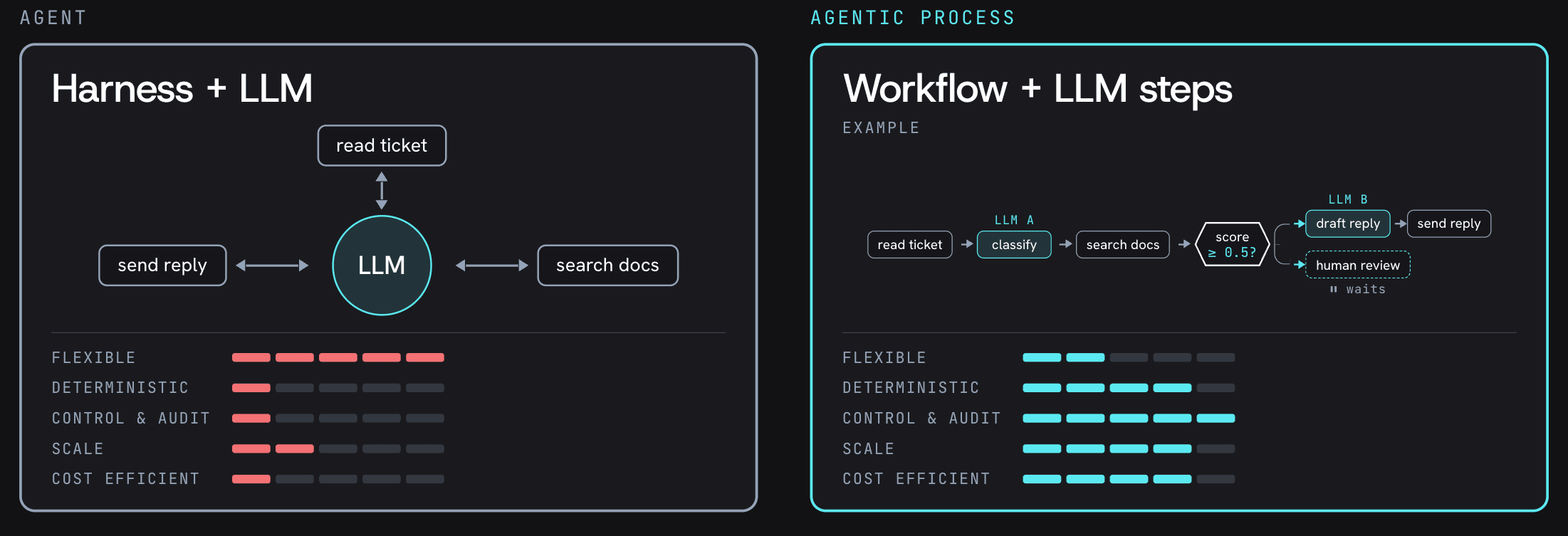
This approach offers exceptional flexibility. However, it also comes with several drawbacks:
- Results are not always predictable.
- Individual decisions can be difficult to monitor and audit.
- Scaling becomes more challenging.
- Running powerful AI models can be expensive.
These limitations may not be a major concern during experimentation. But they become critical when building a business process that needs to operate reliably every day.
The Solution? Don't Give AI More Freedom Than It Needs.
The fundamental principle behind production-ready agentic systems is surprisingly simple: AI should only make decisions where its intelligence is actually needed.
Instead of relying on a single general-purpose agent to manage an entire process, we can build a structured workflow consisting of smaller, clearly defined steps.
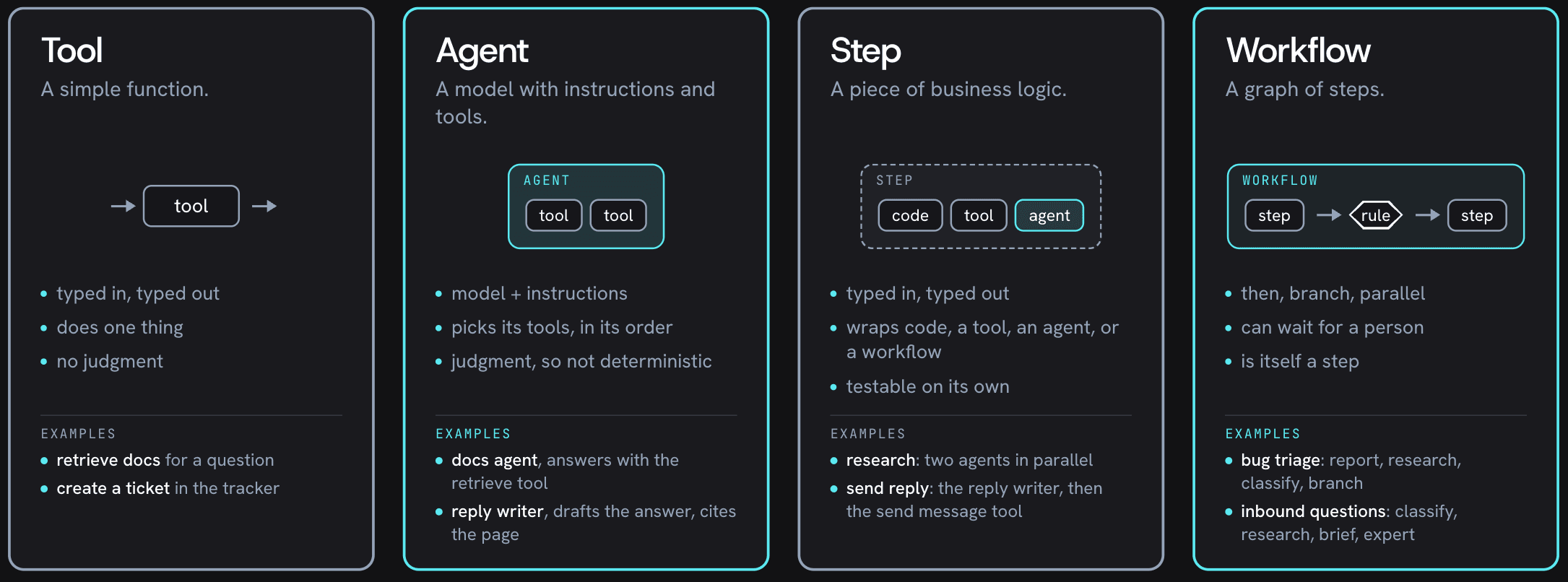
In practice, this involves four core building blocks:
- Tool: A specific function that performs a single task, such as retrieving documentation.
- Agent: An AI model equipped with instructions and only the tools it needs.
- Step: An independent unit that combines application logic, tools, and potentially AI agents.
- Workflow: The complete process that defines the sequence of steps, branching logic, and situations requiring human intervention.
The result is a system that sacrifices some of the flexibility of a general-purpose agent in exchange for greater predictability, control, and efficiency.
A Practical Example: AI Automates Software Bug Triage
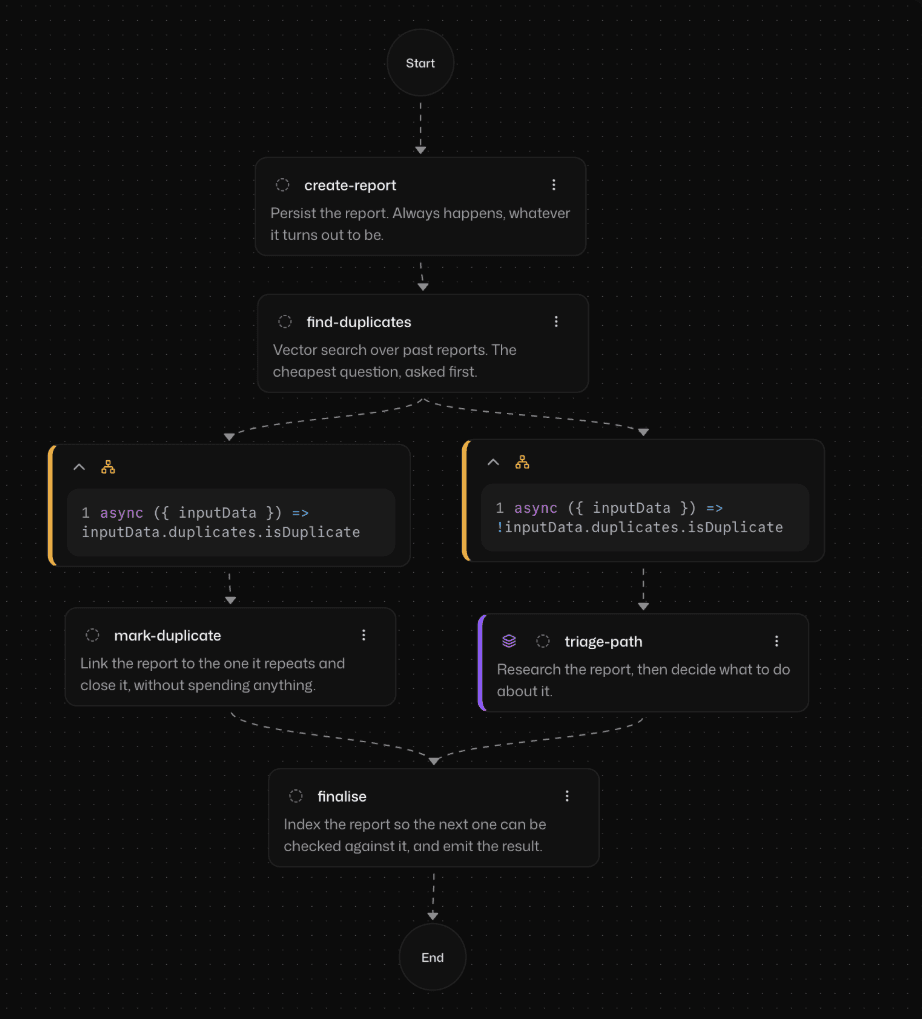
During his talk, Vojtěch demonstrated a concrete workflow for automating the handling of software bugs.
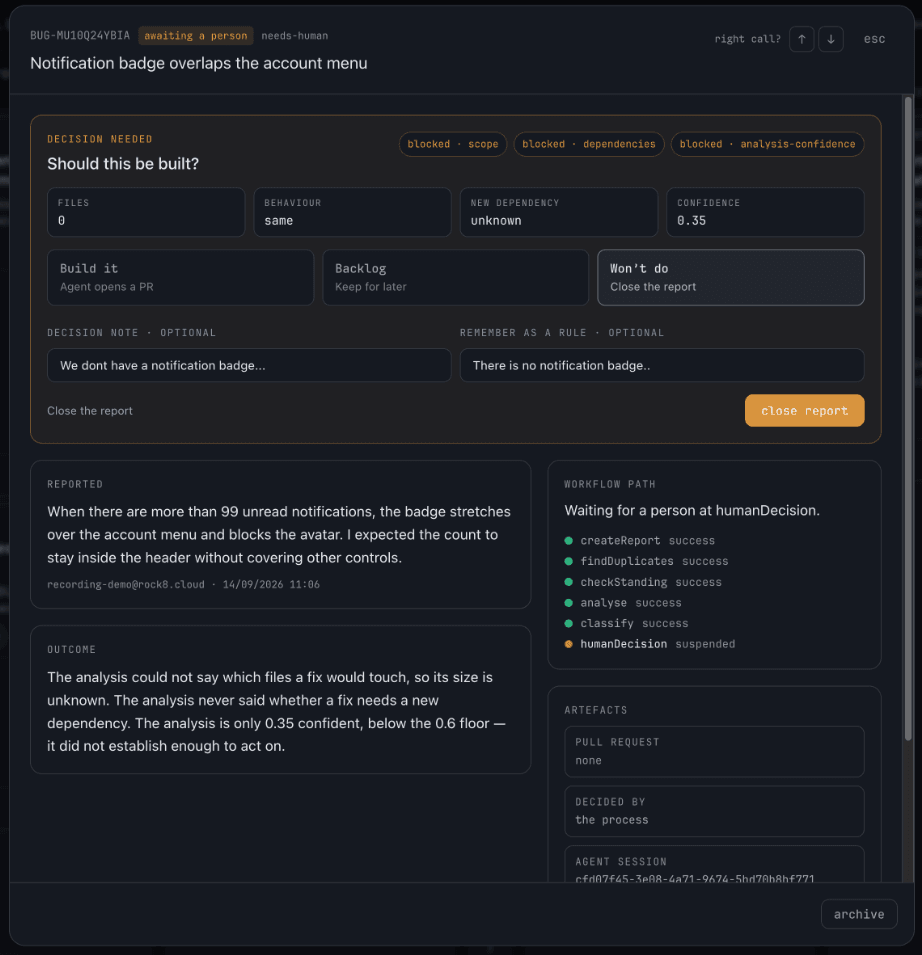
Once a user reports an issue, the system can:
- Analyze the report: AI examines the documentation and source code to determine whether the reported issue is actually a bug.
- Evaluate the issue: It determines whether the report is invalid, requires a simple fix, or involves a more complex problem.
- Respond automatically: If the issue is not a bug, the system prepares a response to the user. For a straightforward fix, it can create a pull request.
- Involve a human: If the system lacks sufficient information or cannot make a decision safely, the workflow pauses and requests human intervention.
Resume the process. Once a human has made a decision, the workflow continues from where it left off.
This is no longer a one-off prompt. It becomes part of an existing software system that can automatically respond to events.
A workflow can be triggered automatically, for example, when a ticket is created, through a webhook, or as part of a scheduled check of system logs.
What Happens When AI Makes a Mistake? We Need to Know Why.
One of the most important aspects of production AI is observability.
Every workflow step should store information about its inputs and outputs. Tracing also makes it possible to track the model used, its decisions, and the execution of individual steps.
This allows us to understand why an agent behaved in a particular way, identify errors, and continuously optimize the process.
Equally important is ongoing quality assessment through evaluations.
These can operate in two ways:
- Offline evaluations: Testing changes to models, prompts, or workflow logic before deploying them to production.
- Online evaluations: Continuously monitoring results during actual operation to detect changes in AI model behavior.
Quality can be assessed using both traditional automated tests and other AI models.
A More Powerful Model Isn't Always the Better Choice
Structured workflows also make it possible to optimize costs.
Not every task requires the most powerful and expensive AI model. A simpler task involving documentation retrieval may be handled by a more affordable model, while more complex decisions can be assigned to a more capable one.
Evaluations make it possible to compare the quality of different models and make decisions based on actual results.
In his talk, Vojta gives an illustrative example: a more affordable model might deliver results that are only 2–3% worse, while reducing costs by as much as 98%. In such a case, using the smaller model can be significantly more cost-effective in the long run.
The goal is not to use the most expensive AI, but to achieve the required quality at a reasonable cost.
So, When Does an AI Agent Stop Being an Experiment?
An AI agent stops being an experiment when it becomes part of an existing software system. When its intelligence is used only where it delivers real value, while the rest of the process remains clearly defined, controllable, and measurable.
When we know what it is supposed to do, can monitor its decisions, measure its results, test changes, and involve humans when necessary.
This is exactly how we approach the development of agentic AI systems at ProRocketeers. We use our own platform, Rock8Cloud, to deploy and run them.
AI doesn't need to control the entire process. It needs to be properly integrated into a process we can control.
See It in Action
In his talk, When Does an Agent Stop Being an Experiment and Become a Process?, Vojtěch demonstrates a real implementation of an agentic workflow in TypeScript, including testing, observability, and a user interface for managing automated processes.
And the best part?
The demo application is also available as a blueprint in Rock8Cloud. You can deploy it yourself and run the entire automated workflow on your own code repository.
💻 Explore the demo application on GitHub
Ready to Move AI from Experiments to Real Business Processes?
At ProRocketeers, we design and develop custom agentic AI systems that integrate artificial intelligence with existing applications and business processes.
We offer companies free introductory AI training, hands-on workshops, support in building AI rapid prototyping teams, and custom AI agent system development.
You might also like
 Agentic Engineering
How to Build an AI Agent You Can Trust: 6 Steps from Prompt to Production Workflow
From the first prompt to a reliable AI agent. 6 steps tested in practice.
 AI & QA
AI in QA: From ChatGPT Experiments to Agentic Testing
AI is changing how developers work. But what about QA, and where does AI fail?
 Projects
Team as a Service: When You Need a Team, Not Another IT Department
What is TaaS, when does it make sense, and how is it different from agency…